Why We Built BirBozor — and Why Now
Technology: 29 тыс сум — compare prices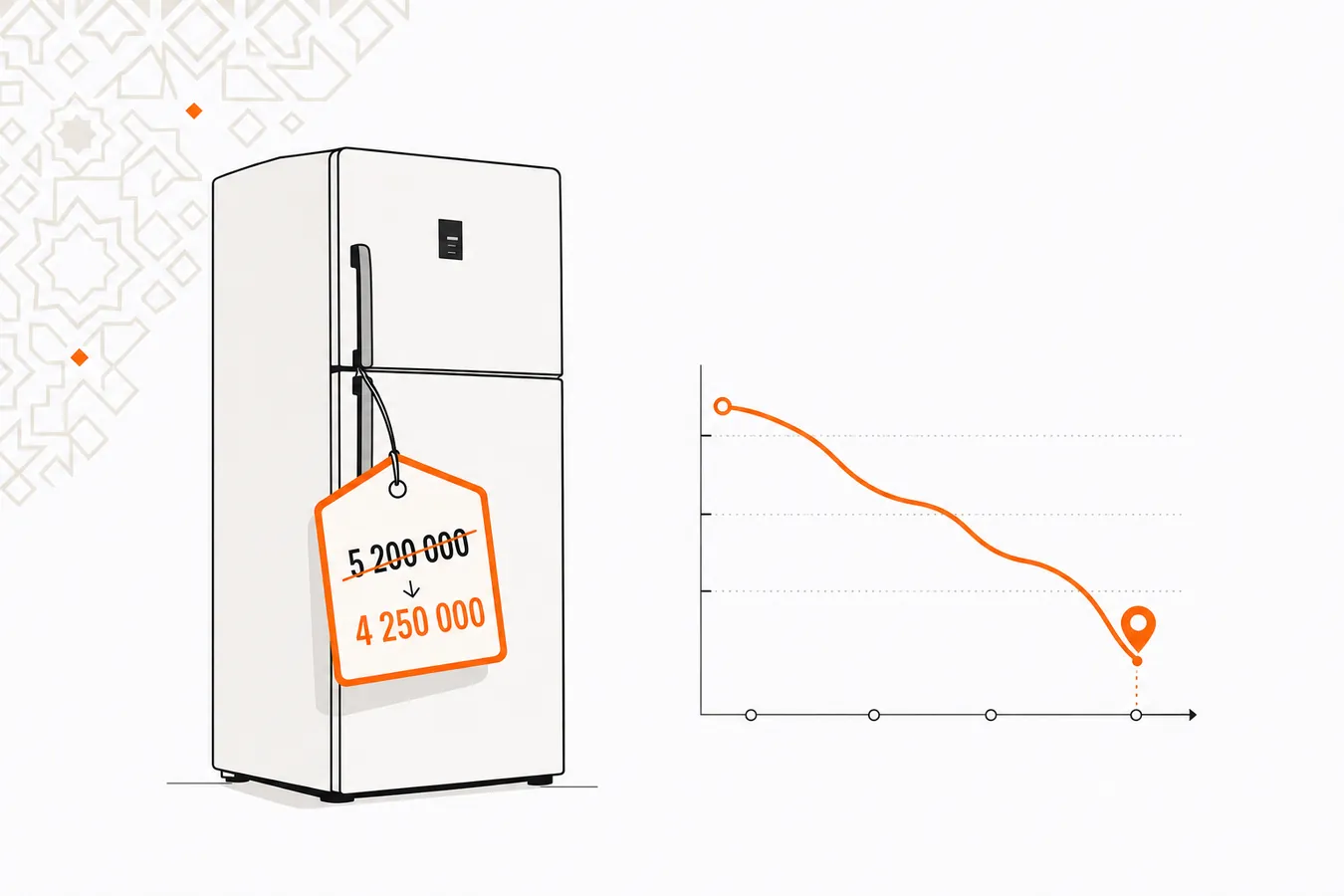
Products and prices for this topic
View the full category →

A friend of mine bought a Samsung refrigerator in August 2025. A big one, 500 liters, with an inverter compressor. The website of a major marketplace showed "−30%, was 12 million UZS, now 8.4 million." He forwarded me the link, I nodded, he bought it. Three weeks later my mom needed a fridge of the same series. I opened the same marketplace and saw the same picture: "was 12 million, now 8.4 million, −30%."
I dug into the Wayback Machine. Wayback is a public archive of the internet where enthusiasts save dated copies of pages. Coverage of Uzbek marketplaces is thin, but for this particular listing I got lucky: there were five snapshots, two or three weeks apart. All five showed the same price — 8.4 million. The earliest snapshot was taken 84 days before I opened the page. For eighty-four days the price hadn't moved. The "old price" of 12 million had never existed in reality. It was a label. A marketing decoration painted over an ordinary price tag.
I sat in front of the screen for about fifteen minutes. What irritated me wasn't the deception itself — I'd known about that before. What irritated me was that to see it, I needed fifteen minutes, two open tabs, and a tool that my friend and my mom don't even know exists. Thousands of people in Tashkent were looking at that same listing in that very minute and believing in "−30%." And there was no simple way to tell them: "no, this isn't a discount."
A week later I started writing the first version of BirBozor.
9 months
From August 2025 to May 2026, it took nine months. That's not a fast launch. And it wasn't done by one person — BirBozor currently has three people in development plus me as CTO of iota.uz. Let me tell you what we built and what we cut.
What we built: a price-collection pipeline across five marketplaces via Firecrawl, running twice a day, about 18 dollars per cycle. A cross-marketplace SKU matching system (described in detail in last week's piece): 340 thousand SKUs, 62 thousand matched pairs, false-positive rate below 0.5%. A Postgres core with a schema for prices and history. Drizzle on the admin side. An Expo app for iOS and Android. A Next.js site, birbozor.uz. A Python backend for all the heavy processing. SMS OTP via Eskiz — the only channel that makes economic sense in Uzbekistan (95 UZS per code, about 0.008 dollars).
In parallel, we obtained IT-Park residency. That's not a marketing move — it's arithmetic. Residency grants simplified taxation and currency operations, without which the SaaS model in Uzbekistan falls apart at the seams. At the zero-revenue stage, the tax savings decide whether the project makes it to release or not.
We cut a lot. We cut a separate B2B portal for brands at launch — it'll come, but not in the first version. We cut price-alert push notifications about competitors for sellers — that's a different product. We cut bank-card integration for cashback returns — too much regulatory weight for a team of four. We cut voice search input. We cut the "reviews" section. The first version kept only three screens: product search, a product card with a 30-day price chart and a comparison across 5 stores, and a tracking-subscription page.
What almost killed the project
Several times I was close to shutting BirBozor down.
The first crisis was the marketplaces' terms of service. All five platforms have language in their ToS prohibiting automated data collection. It's a legal gray zone: a price is public information, but automation is explicitly forbidden. For three weeks I talked to three lawyers, read precedents in the EU and the US, reread hiQ Labs v. LinkedIn. The conclusion we reached: we collect only publicly available prices, no personal data, we give the link and attribution back to the original marketplace, and at the first written demand from any platform we remove its listings. It's not a cure-all. But it's a position you can live with.
The second crisis was the fear of being blocked. If BirBozor goes into a public press campaign and we get written about, what happens to our scraper? It gets IP-blocked within a day. We prepared for this: proxy rotation, fallback through Firecrawl from different regions, a collection speed deliberately kept low so as not to look like a DDoS. And still, deep down, the fear sat there: what if they just cut us off the morning after the first big article. That fear hasn't gone away. I've learned to live with it.
The third crisis was the market. In Uzbekistan, online-commerce penetration is around 12 percent. In Poland it's 30, in Turkey 25. Twelve percent is a small pie. For six months I kept asking myself: am I building a tool for a market that hasn't matured yet. The answer I found for myself: penetration grows 4–5 points a year, and in two years it'll be 20%. By the time the market matures, the infrastructure has to be in place. Whoever is late with infrastructure is late forever.
The fourth crisis was the absence of a sales department. iota.uz is a technical company; we know how to build, we're bad at selling. BirBozor is built on the assumption that we won't have a sales team, and the affiliate model with marketplaces is our only initial monetization channel. That's a deliberate self-constraint. If a user loves the product, they'll spread the word themselves. If they don't love it — sales can't fix that.
What changed on October 21, 2025
In the 7th month of BirBozor's development, something strange happened. The Cabinet of Ministers passed a resolution banning false discounts. As of October 21, 2025, the "old price" from which a discount is calculated is required to equal the minimum price of that item over the preceding 30 days. Spot.uz published a breakdown hot on the heels of it.
This was exactly the norm we had been building the product around for the seven months before that. The 30-day price chart, the "discount is real / discount is fake" marker, the automatic comparison of the claimed "old price" against the window's minimum — all of it was already baked into the architecture. Not because we knew about the resolution in the works. But because the 30-day rule is the obvious honest standard, and we arrived at it by the same logic the regulator did.
We didn't pivot. The regulator caught up.
This is a rare moment in the life of a B2C product, and I'm recording it in detail because I'll forget. For seven months you build something without knowing whether the law will change in your favor or against you. And suddenly it changes in yours. This isn't a "coincidence" — it means you saw the structural problem correctly. But at the same time it's enormous luck with timing.
Why iota.uz and not a separate startup
I'm often asked why BirBozor lives inside iota.uz rather than as a separate company with a separate round. I have three reasons.
The first is the cost of development. iota.uz already builds corporate software for several clients. Platform components — billing, authorization, task queues, monitoring, infrastructure — we already have. A separate startup would have spent its first six months on infrastructure that we pulled off the shelf. That saves roughly 200 thousand dollars at the zero stage.
The second is the monetization model. BirBozor earns from affiliate commissions with marketplaces and from B2B data that we'll sell to brands and analysts later. We plan no outbound sales into this B2B layer — it'll be a cold, on-demand product. iota.uz covers the runway horizon: even if BirBozor doesn't turn a profit for three years, I won't shut the product down.
The third is positioning. I don't want to make BirBozor "a startup chasing investment." I want to make a tool that's useful to a buyer in Uzbekistan. If there's revenue — we reinvest it. If there isn't — we keep it running on the back of the core company. That's slower, but it's more honest toward the user: we won't crank up monetization to show investors an "exit-ready cohort."
What we're launching on Monday
On Monday, July 13, 2026, the beta opens. The first 100 beta users get the "Tejovchi" role (Uzbek for "thrifty") — it stays with them forever and grants early access to new features.
In the Telegram channel @birbozor_uz we've been publishing daily manual checks of real products for eight weeks now. It was a soft reconnaissance-in-force: to make sure there's an audience, that the format works, that the tone lands. The channel now has about 4 thousand subscribers, and the average post reach is above 60%.
Right after the beta — a gradual opening, with no ad campaign, organically through the Telegram channel and through invitations from the first users. No billboards and no YouTube pre-rolls in the first month. First we verify that the product holds up under load, then we grow.
If you're a buyer in Uzbekistan
Join the Telegram channel @birbozor_uz — there are daily checks of specific products, and that's where the beta-launch announcement will be too. Details are at birbozor.uz; early users get the "Tejovchi" role.
If you're building something similar
We openly publish our methodology and part of the code. The marketing/research section of our repository holds breakdowns of the regulation, audit sets for SKU matching, and Firecrawl economics calculations. In the Telegram channel @birbozor_dev I write about engineering decisions once a week. If you have a similar problem in another country — message me directly, let's talk. This market isn't zero-sum. The more transparency there is in CIS e-commerce, the better for everyone.
Save a product in BirBozor — we show the 90-day low next to the current price tag.
Subscribe @birbozor_uz