Fake Discounts Banned from October 21, 2025: What Changed for Shoppers
Technology: 99 тыс сум — compare prices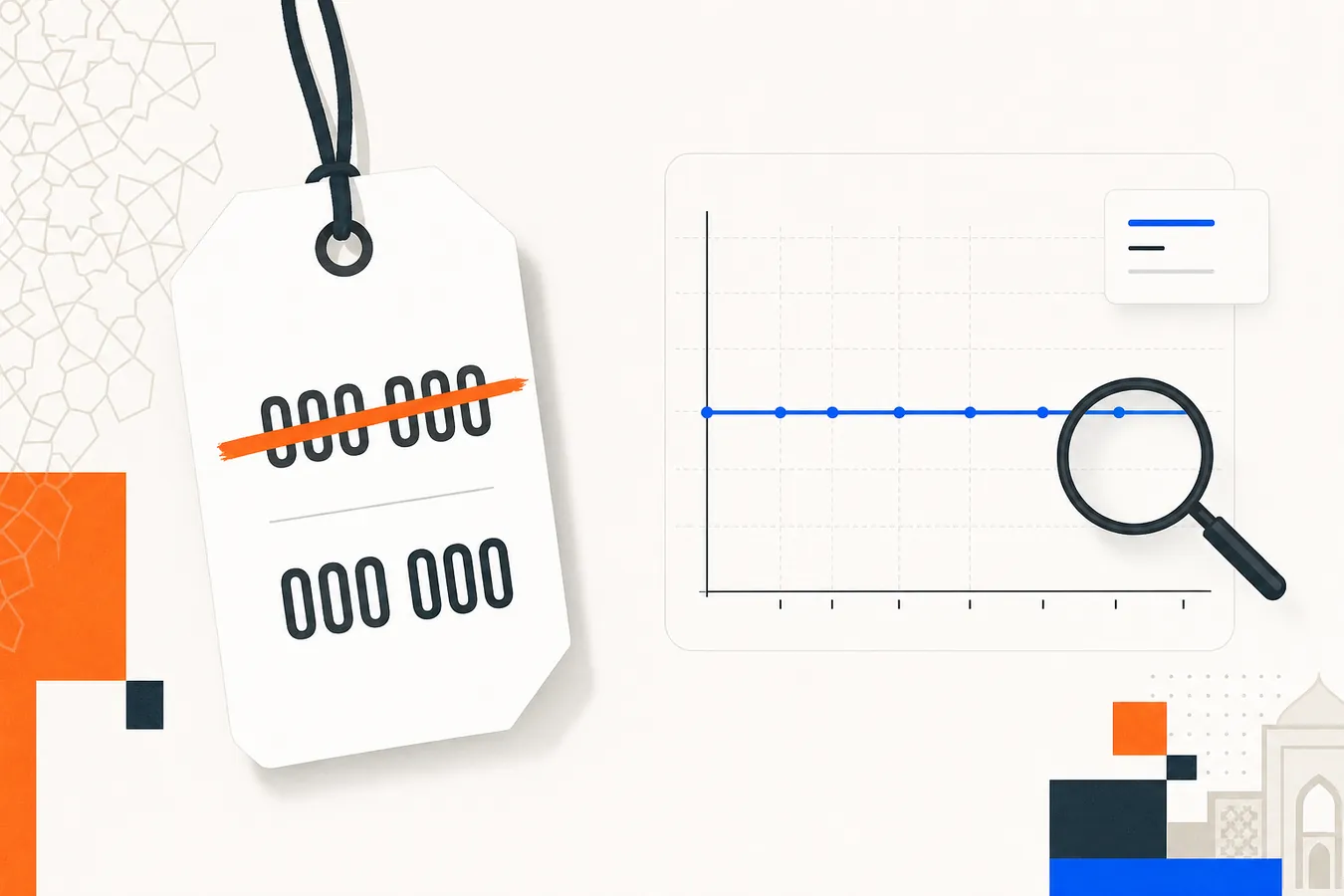
Products and prices for this topic
View the full category →


Six months ago a friend of mine bought a Samsung refrigerator on one of the major marketplaces. The site showed "−30%, was 12M UZS, now 8.4M." Three weeks later I needed the same one. I open it up — same model, same "−30%," same 8.4M. I scrolled through the cache on the Wayback Machine. The price of 8.4M had been sitting there for 84 days straight. The "old price" of 12M never existed. It wasn't a promotion. It was just the price tag.
The story is completely typical. And as of October 21, 2025, it is officially illegal.
On that day the Cabinet of Ministers of Uzbekistan adopted a decree that bans artificially inflating a price before a "promotion." The text is available on lex.uz. In short — a seller can no longer invent any "old price" they find convenient to count a percentage off. "Was" now legally means "the minimum price of this product over the last 30 days."
This tiny-looking line overturns the entire economics of marketing on local marketplaces. Below is exactly what happened, why, how it works in practice, and how to check a receipt today.
What Was Adopted
The key wording of the decree is short: "artificially inflating the price of a product is prohibited." This refers to the classic scheme: one or two months before a sale, the seller raises the "regular price" to a fabricated level, and on the day of the promotion draws "−40%" against that fabricated level. The shopper sees a "promotion" but actually pays the same as, or close to, the usual price.
To close the loophole, the decree builds in a simple numeric rule: the "old price" from which the discount is calculated must equal the minimum price of this product over the past 30 days. The same logic has been in force in the European Union since 2022 (Omnibus Directive), and the Antimonopoly Committee's preparatory materials explicitly cite precedents from the US, Canada, France, Germany, China, Korea, and Japan.
In other words, Uzbekistan didn't reinvent the wheel — it caught up to the standard.
Why Now
In 2025 the Antimonopoly Committee received more than 48,000 complaints from citizens. The bulk of them were about providing consumers with false information. This is a public figure, not an estimate. Forty-eight thousand people believe they were deceived, and took the trouble to file a complaint.
In parallel, in May 2025 government monitoring uncovered around 220 counterfeit products on Uzum Market and around 50 on Olcha — Adidas, Samsung, Bosch, Chanel passed off as originals. In December 2025 the Committee warned about schemes involving fictitious bonus gifts and forced installment plans targeting pensioners.
This is the context in which the October decree appeared. The regulator wasn't reacting to an abstract problem — it was catching up to a real stream of complaints.
There is an industry context too. Russian Forbes, in one of the most cited studies of retail across the CIS, found that 75% of "promotions" on Black Friday are fake: only one in four products is actually sold at least 10% cheaper, and 28% of "discounts" don't exist at all. The Uzbek market copied this model one to one.
What "30 Days" Means in Practice
Take the refrigerator the article started with.
March 1. Price 8.4M. March 15. The seller raises the price to 12M. March 20. A "promotion" appears on the site: "was 12M, now 8.4M, −30%."
Under the rules before October 21, 2025, this was a gray area: formally, the price really was 12M on the site for five days.
Under the rules after October 21, 2025, it is a violation. The "old price" must be the minimum over the past 30 days. The minimum in the 30 days before March 20 is 8.4M (it held from March 1 to March 14). So legally "old" = 8.4M. The discount from 8.4 to 8.4 is 0%. There is no promotion.
The same rule breaks the popular pre-season game. You can't set the price to 1.5× a week before a sale and then roll it back — on a 30-day window the minimum still stays at the old level. There is only one way to make a promotion real: lower the price below whatever it was over the last 30 days.
The convenience of this rule is that it is verifiable. Not "the seller acted in bad faith" (which is hard to prove), but "here is the number, here is the window, it's settled by arithmetic."
How to Check It Yourself
A check is the search for the answer to a single question: "what was the minimum price of this product over the last 30 days?"
Without tools there are three ways:
1. Screenshots. If you visited the product earlier in the month and saved a screenshot, you have a reference point. In practice no one does this.
2. Web Archive. The site archive.org/web saves copies of pages. If you're lucky and someone "archived" the page on the right day, you can see the price at that time. Coverage of Uzbek marketplaces is poor — the day you need may not be there.
3. Other people's reviews. On otzovik, 2gis, and Yandex.Maps users sometimes mention the price they saw. It isn't strict proof, but it gives a benchmark.
All three share one thing: they take 10–20 minutes per product, and they work poorly. So if you're choosing between two refrigerator models across three marketplaces, that's already an hour of manual work before you can even start comparing prices.
This is exactly the pain BirBozor exists for. We record the price of every tracked product across all five major stores (Uzum, Olcha, Asaxiy, Texnomart, Mediapark) every day. A 30-day history is a built-in chart on every product card. To tell whether a "promotion" is real, a single glance is enough.
What Sellers Face
The decree works in tandem with the existing rules on advertising and consumer protection. Complaints are handled by the Antimonopoly Committee. Possible measures:
administrative fines for misleading advertising an order to remove the "promotion" from the platform public recording of the violation (in the Committee's practice this works as a reputational measure)
What matters: this is not theory. In April 2026 the Committee fined six developers for false discount advertising. Even after the October decree there was a dispute between the Committee and a Yandex/Uzum ad placement. The precedents exist. The regulator is learning to apply the rule to marketplaces.
How BirBozor Shows the 30-Day Check in One Tap
BirBozor is an app that tracks prices for the same products across several Uzbek marketplaces at once. On any product card we show three things:
A grid of prices across 5 stores right now. The cheapest is marked green. You can see at a glance where it's cheaper today. A 30-day price chart. On the same screen, below the grid. The chart immediately shows that very "30-day minimum" — exactly the number that, under the new law, a "promotion" must be measured against. A "promotion is real / promotion is fake" marker. If a store is currently showing "−X%," we automatically compare the claimed "old price" with the minimum over the last 30 days. If the claimed price is higher, you have a ready-made argument for a complaint to the Antimonopoly Committee.
There is no magic algorithm in this. It is the same arithmetic the law now requires, just without the manual work with screenshots and the Wayback Machine.
BirBozor is currently in a pre-release stage. The beta opens in 8 weeks. Until then we publish daily manual checks of real products in our Telegram channel — so you can start using the 30-day rule today, rather than waiting for the app's release.
What to Do Right Now
Subscribe to our Telegram channel @birbozor_uz — every day we post 1–2 checks on real products. With a 30-day history and a clear verdict: "promotion is real / promotion is fake." When you see a "promotion" in a store, ask "what was the minimum price over the last 30 days?" If the store doesn't answer — that's already a signal. Open birbozor.uz — price comparison and discount checking already work on the site.
The law is already in force. The only question is which shoppers will learn to use it before everyone else.
Save a product in farq.uz — we show the 90-day low next to the current price tag.
Subscribe @farq_uz