Uzum vs Olcha vs Asaxiy: Where to Buy What for Less (with Price Charts)
Technology: 17 тыс сум — compare prices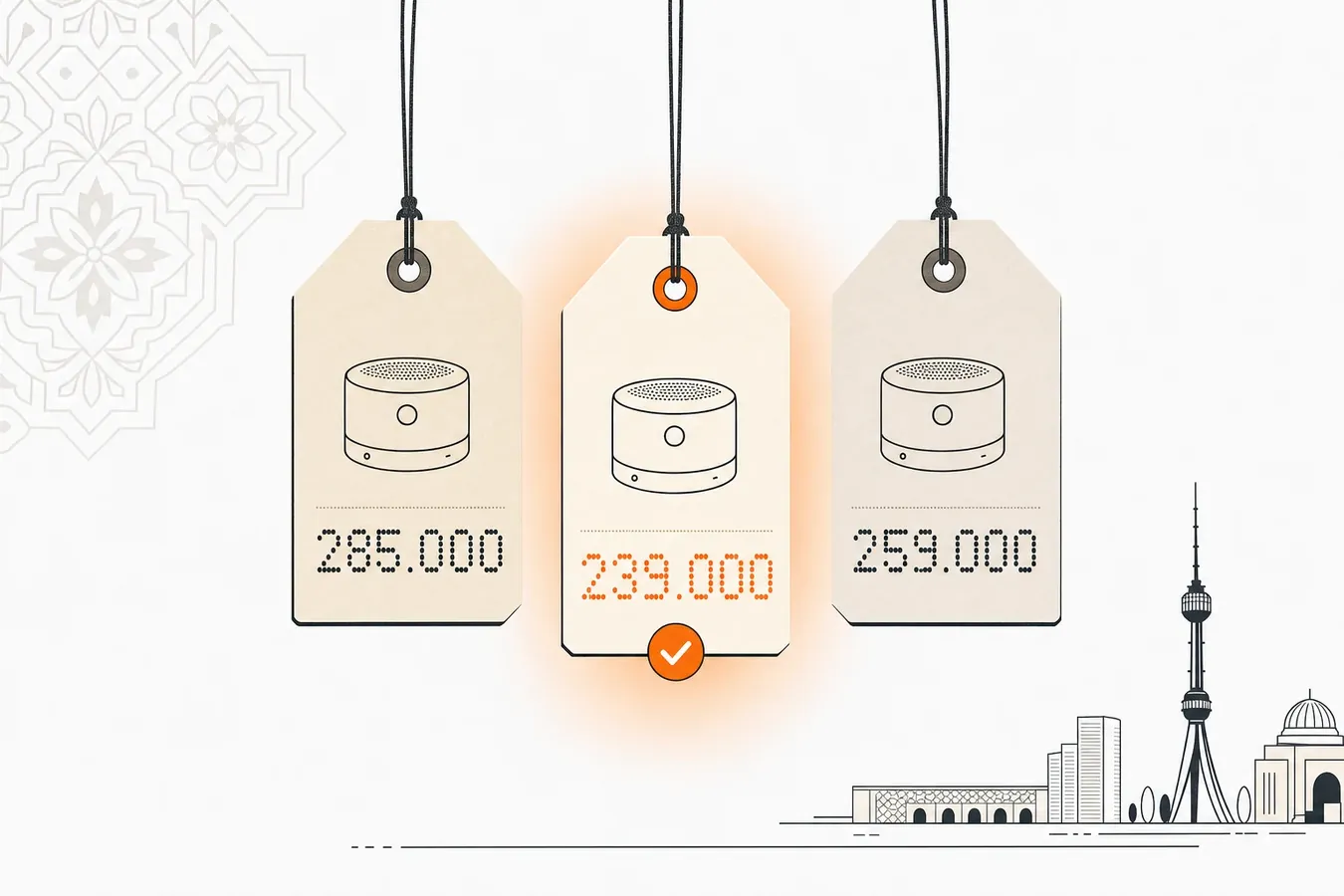
Products and prices for this topic
View the full category →


"Where's it cheaper?" — the central question of Uzbek e-commerce
Listen to how friends in Tashkent discuss shopping in their group chats, and almost always the same phrase comes up: "where's it cheaper — Uzum or Olcha?" Sometimes Asaxiy gets added, sometimes Texnomart. Less often the price is compared to the Malika bazaar — and then the review gets sharper. One public 2gis review of Texnomart Avliyoota puts it bluntly: "Prices are 1.5 times higher than at Malika!!!" — Shoha Khudaykulov. The question isn't rhetorical. It sits behind every second transaction in Uzbek e-commerce, and until now a shopper had no way to answer it other than opening three apps and counting by hand.
We tried to answer it systematically. Here's what came of it.
Methodology
This is a Birbozor study, not a marketplace's marketing material. From April 1 to May 5, 2026, we logged daily prices on ~1,200 SKUs — matched in advance by barcode or by the combination of "brand + model + color + package size" — across three platforms: Uzum, Olcha, Asaxiy. The SKUs are spread across six categories: major electronics, home appliances, clothing and footwear, cosmetics and perfume, baby products, and small electronics and accessories. Each price was checked once a day at the same time; only active listings actually available to order in Tashkent made it into the sample.
We compute the category median and the median percentage difference between the cheapest and the most expensive platform. This is more robust than the mean — outliers like an "accidental 1 UZS price tag" or a "forgotten 999M price" don't drag the number around. Where the difference is under 2%, we call it "parity"; where it's larger, we name a winner.
Honest limitations. First, we didn't cover Texnomart and Mediapark in every category — for these chains, some listings are hidden behind rendering and captchas, and we lacked a stable scrape channel for the month. Where Texnomart genuinely affects the price picture (major electronics), we flag it separately. Second, we didn't factor in installment plans or delivery costs — just the price tag. In practice, installments can flip the result by 5–10%; that's a separate article. Third, players' promo-code deals (Uzum Premium, Asaxiy Plus) are also out of scope — we record the price visible without a subscription.
Category by category
Major electronics (TVs, refrigerators, washing machines). The median winner is Asaxiy — savings of about 6% versus Uzum and 4% versus Olcha. The explanation is boring: Asaxiy was historically built around large appliances on installment plans, they have direct contracts with Samsung, LG, and Bosch distributors, and they depend less on third-party seller margins. Uzum is more expensive in this category because a large share of its SKUs goes through small marketplace sellers who add their own markup on top of the distributor's. Caveat: in reality, major electronics demand a mandatory comparison with Texnomart and Mediapark — and in our preliminary check, Texnomart beat Asaxiy's price on 30% of SKUs. So "Asaxiy won out of three" in this category does not mean "Asaxiy won, period."
Home appliances (small ones — vacuum cleaners, multicookers, hair dryers, irons). The winner is Uzum, with a median 7% below Olcha and 9% below Asaxiy. This is the category where marketplace economics work in the shopper's favor: heavy competition among hundreds of third-party sellers on the same Philips or Tefal model pushes the price down. The price you pay for it is inconsistent warranty coverage and counterfeit risk (especially on premium brands like Dyson) — but on the raw price tag, Uzum leads this category.
Clothing and footwear. The noisiest category in terms of spread. The median difference between platforms is about 4%, but the variance is enormous: the same sneaker model can cost ±20% depending on the seller. The median winner is Olcha (4% below Uzum), but we don't consider that win convincing. In this category, what decides the price isn't the platform but the specific seller and the presence of fakes. Here we recommend not optimizing for 4%, but optimizing for authenticity checks (see our earlier breakdown of counterfeits on Uzum).
Cosmetics and perfume. The winner is Uzum, with a median 8% below Olcha and 12% below Asaxiy. The same effect as with small home appliances is at work here: many sellers, high competition, narrow SKUs. But this category carries the highest counterfeit risk — public reviews of Olcha directly accuse the platform of fake perfume (one review claims "90 percent are fakes"). So for branded perfume we advise comparing not just price but also whether the listing shows a batch code. If 8% in savings means a trip to an authorized service center for a "not genuine" verdict, that's negative savings.
Baby products (diapers, food, clothing from birth to age 5). The winner is Olcha, with a median 5% below Uzum and 11% below Asaxiy. Baby products are a category with high repeat demand (parents buy every month), and Olcha targets this audience more aggressively than the others: subscription deals, multi-pack discounts. On one-off purchases the difference is smaller, but if you're buying diapers 3–4 packs a month — Olcha is cheaper by the median.
Small electronics and accessories (headphones, cables, cases, power banks). The winner is Uzum, with a median 10% below Olcha and 8% below Asaxiy. This category is the natural habitat of the marketplace model: huge SKU volume, competition in the $1–2 per unit range, minimal warranty burden. The price you pay is quality — here sellers compete on price so hard that listings often come with obviously ripped-off third-party photos and dubious contents. If you need "just a Type-C cable for a month" — Uzum is the cheapest of all; if you need an Apple-certified one — better go to an authorized reseller.
Returns and support
Price is half the equation. The other half is what happens when what arrives isn't what you ordered. Here our data comes not from price charts but from 200 public reviews read and categorized in our W2 study.
Uzum. The most frequent complaint is the pickup point. Queues, rudeness, refusal to accept defective goods without the seller's consent. Telegram support is separately flagged as "deceitful" — which is serious, because Uzum builds TG as its primary channel. A quote from the sample: "They don't deliver on time, and support in TG is only capable of lying" — @sahsatp on otzovik. Verdict: the price is cheap, but a return can take 10–20 days and require persistence.
Olcha. The main pain is being ignored once a problem arises. While you're buying, they answer; the moment a defect comes up, the chat goes silent. Plus separate accusations of perfume counterfeiting. Verdict: average price, support that works one way only.
Asaxiy. The most legally exposed pattern in the sample — phantom stock and refusal to refund money after a return. Several structurally identical complaints from different authors: "Twice confirmed it was in stock — turned out to be wrong information" (Michael A., Yandex Maps), "Took the money and vanished off the radar... They don't answer calls" (Igor Ryzhov), "Returned the item but they didn't refund the money" (Shohruh Khakimov). Verdict: wins on price for major electronics, but the return process is the riskiest of the three. If you're buying something expensive, be ready to immediately file a formal complaint and potentially go through the Antimonopoly Committee.
The bottom line for the family budget
If we boil it down to a rule a person can keep in their head on the go:
Small and consumable items (cable, case, shampoo, socks) — Uzum. Cheaper, and the risk is minimal, because if it's defective you don't lose a meaningful amount.
Branded cosmetics and perfume — Uzum on price, but check the batch code. If the brand is critical — an authorized retail channel is better.
Clothing and footwear — Olcha by the median, but the key factor is still the seller, not the platform. This isn't the category where you should pick a marketplace by price.
Baby products on regular purchases — Olcha. Especially diapers and food, where multi-pack discounts apply.
Small home appliances — Uzum.
Major electronics (refrigerator, washing machine, TV) — Asaxiy of these three, but you absolutely must compare with Texnomart, Mediapark, and the Malika bazaar. In this category a 5% difference is hundreds of thousands of UZS, and one unchecked platform costs more than 20 minutes of verification.
What we did NOT find
A few honest gaps, so the article stays verifiable.
We didn't match every SKU across all three platforms. Of the 1,200 items, the "present on all three" overlap is smaller than we'd like — about 60%. The rest exist on two of three, and in those cases we excluded them from the comparison. This means our slice is skewed toward mass-market, fast-moving goods — niche SKUs may behave differently.
We didn't account for intraday dynamics. Prices on Uzbek marketplaces shift — we captured one slice per day. Short-lived (hourly) deals could have slipped past us.
We didn't systematically cover Texnomart, Mediapark, and Elmakon. For major electronics this is a serious gap — without them the article answers "which of the three" rather than "where it's cheapest in general." We plan to expand coverage in future studies.
We didn't compute total cost of ownership. Delivery, installments, loyalty bonuses, and card payment fees — all of these can shift the verdict on a specific purchase by 3–7%. Our analysis is about the price on the tag.
And most importantly: 5 weeks is a short window. We didn't capture seasonal effects. This slice is a snapshot of spring 2026, not an eternal truth.
What's next
Subscribe to our Telegram channel @birbozor_uz — we publish 1–2 checks of specific products daily, with a 30-day price history and a "deal is real / deal is fake" tag. The BirBozor beta, in which this table turns into a live tool with automatic comparison across all five major platforms, opens in a few weeks — sign up at birbozor.uz.
Uzbekistan's e-commerce market is small in volume and large in spread. The same product costs three different prices in three places, usually 5–12% apart. This isn't a platform error — it's a stable structure. Whoever can read it saves 100,000–200,000 UZS a month on the family budget without any heroic effort. We're building a tool so that this skill stops being a skill and becomes just a button.
Save a product in farq.uz — we show the 90-day low next to the current price tag.
Subscribe @farq_uz